
The agentic clinic. Starting with fertility.
Not an AI assistant bolted onto a clinic. Software that keeps patient context, moves work forward and coordinates care. Clinicians keep the judgment.
LLMs may have put the legacy EHR back on life support. They cannot make it safe to act.
Language models are remarkably good at two things: turning messy input into structured data, and understanding what someone is trying to do. That is why they can finally make sense of years of unstructured records.
But a legacy EHR stores fragments of a patient's care pathway, not the pathway itself. Staff reconstruct what has happened and what is still required to decide what happens next. Asking a model to make the same inference, and then act on it, is dangerous. Insight without the ability to act is just more work.
So the question is not how smart the model is. It is what decides what is allowed to happen. In Sama, that authority lives in the system.
The treatment is the context, not the chart.
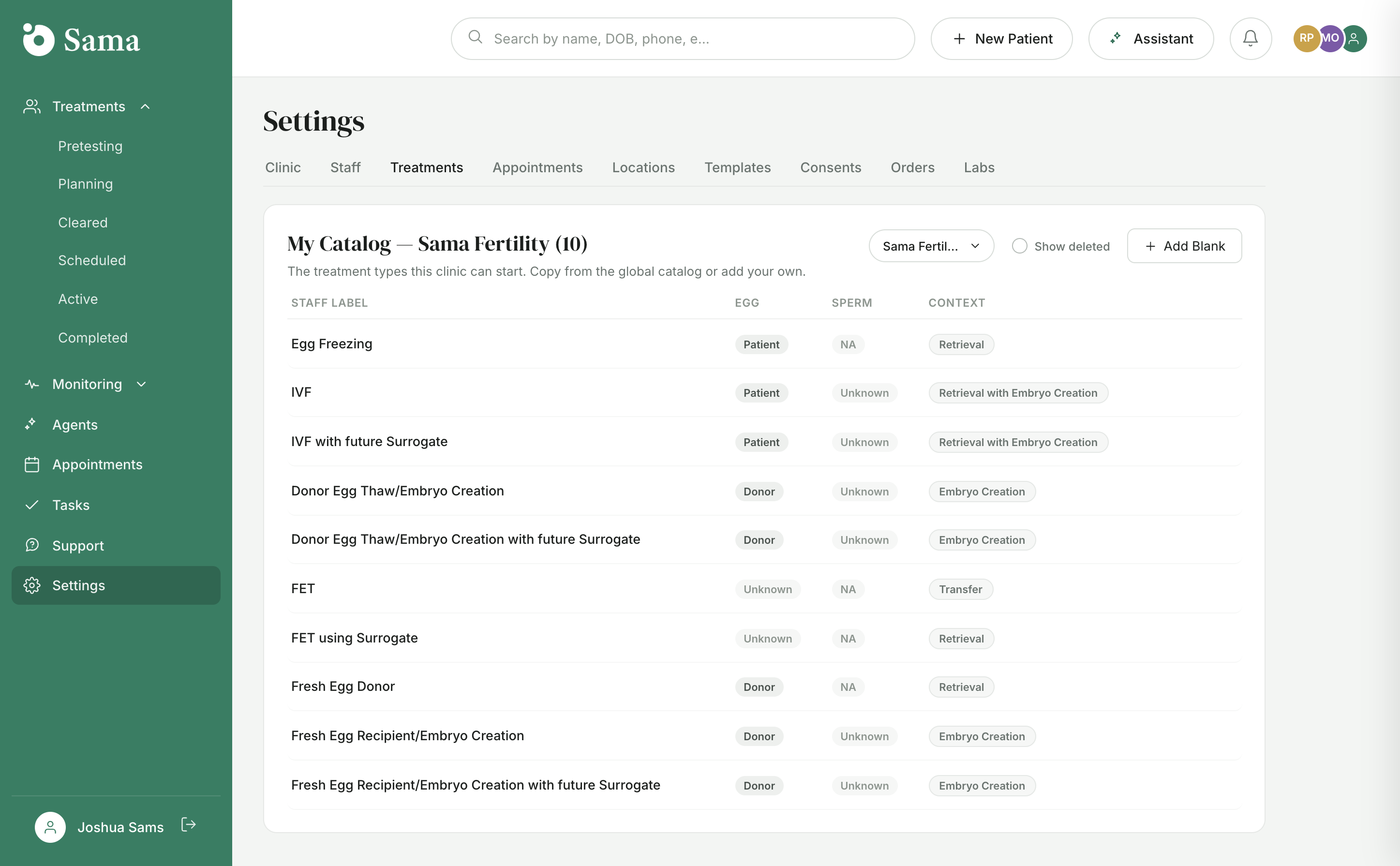
In most systems a treatment is a label. In Sama it is a versioned definition: consents, products, orders, labs, checklists and rules are provisioned the moment a treatment starts, and every patient's status is a computable state.
Every dependency is state
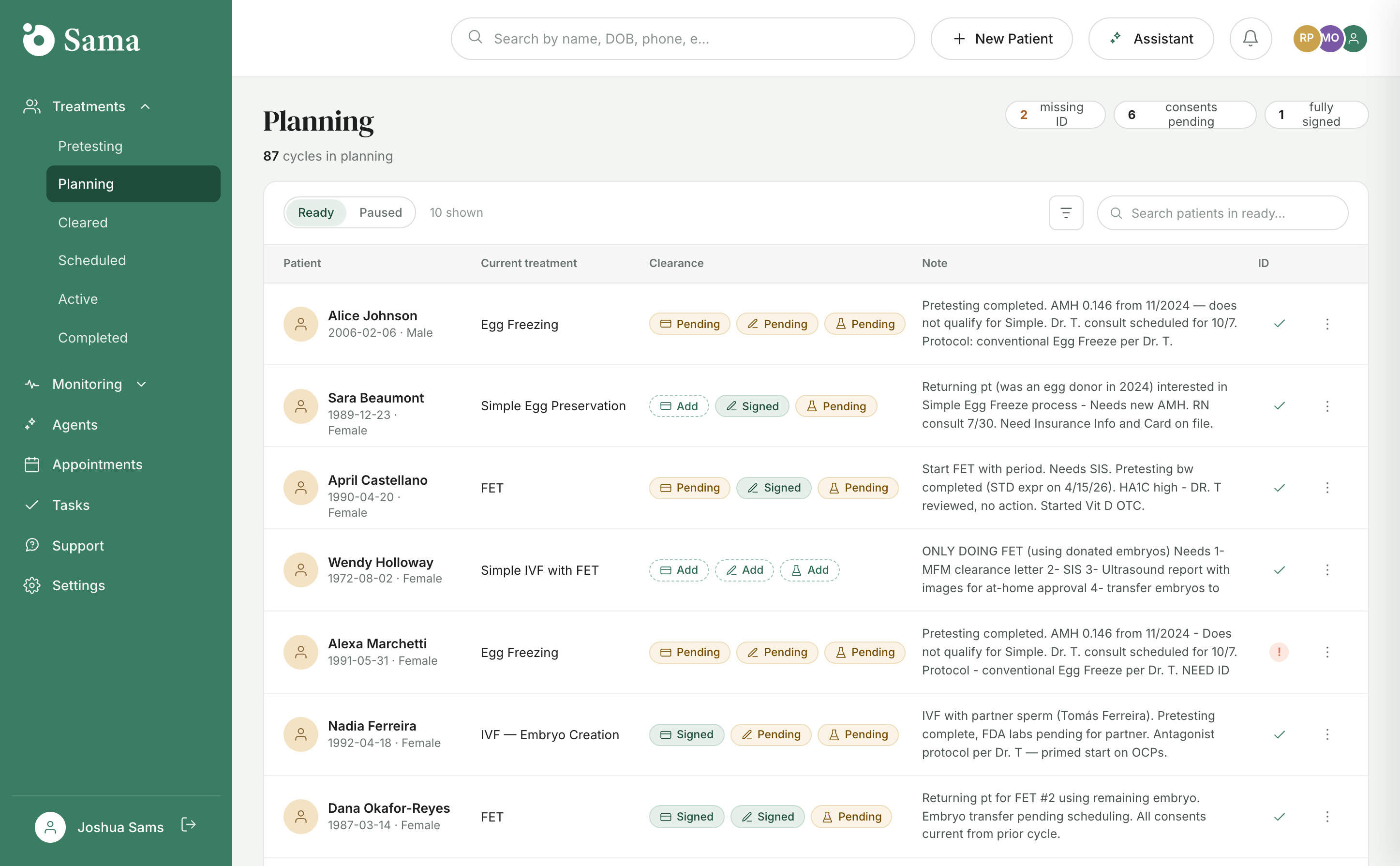
Consents, payment, labs, protocol and identity for every treatment, including third-party dependencies, held as computable state. That is what lets the system decide readiness itself and leave protocol to the clinician.
- Readiness is computed, not reviewed
- Clearance runs when the rules pass; reminders go out when they don't
- Staff see what the system decided and why
Treatments as code
Each treatment is a versioned definition: requirements, permitted actions, transitions, lab panels, rules and checklists. Change the definition once and every cycle inherits it, with an audit trail.
- Clone a treatment to make a variant, keep the history
- Labs link to the clinic's panel catalog with freshness windows
- Checklists describe safe care, not a reminder queue
A formal model of care that AI operates within.
Every treatment is a state machine with explicit requirements and permitted actions. The clinic defines what must happen, which actions the system may take on its own, and which decisions stay with a clinician.
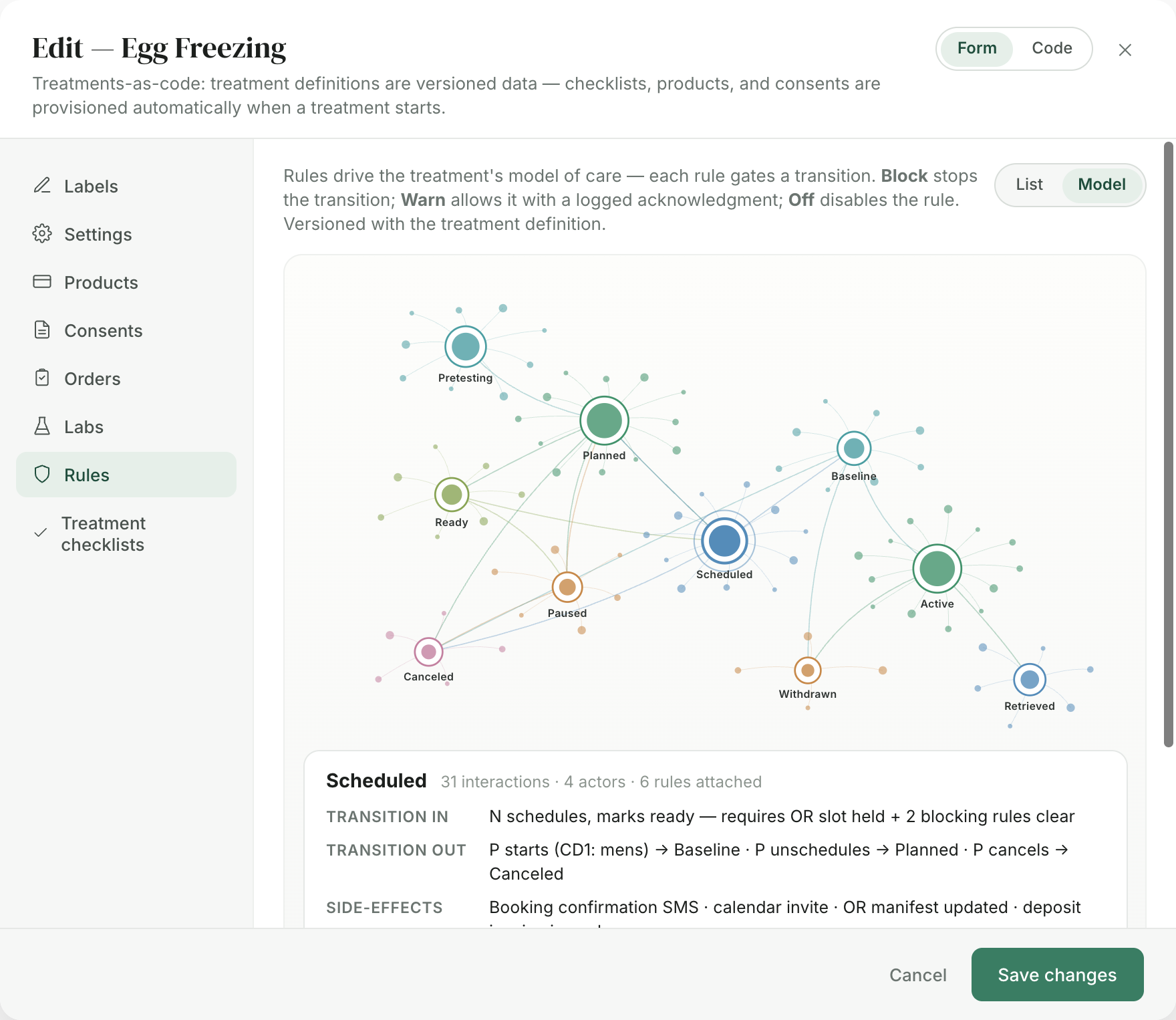
Egg Freezing › Rules › Model. Each node is a state; each rule gates a transition as Block, Warn or Off. Selecting Scheduled shows its 31 interactions, 4 actors, 6 attached rules, side-effects and a 45-day stale timer.
Results must be under 90 days old at the scheduled treatment date. Infectious panel under 12 months. Government ID verified before clearance.
Blocked until every Block rule passes. Warn rules proceed with a logged acknowledgment. Neither staff nor the assistant can skip them.
Scheduled → Baseline fires booking confirmation, calendar invite, OR manifest update and the deposit invoice automatically.
Flags to the nursing queue. Waiting is modelled, so nothing depends on someone remembering to check.
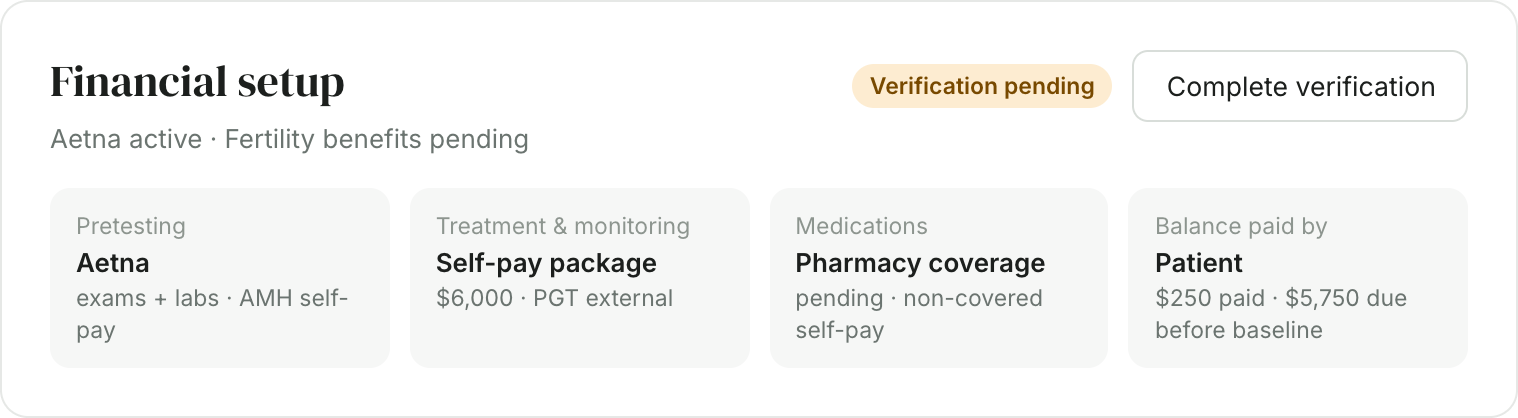
Financial routing is modeled, then applied
Which payer covers which service, under which conditions, is a rule set carried by the treatment. Charges route the same way every time without a human deciding each one; the exceptions are what reach a person.
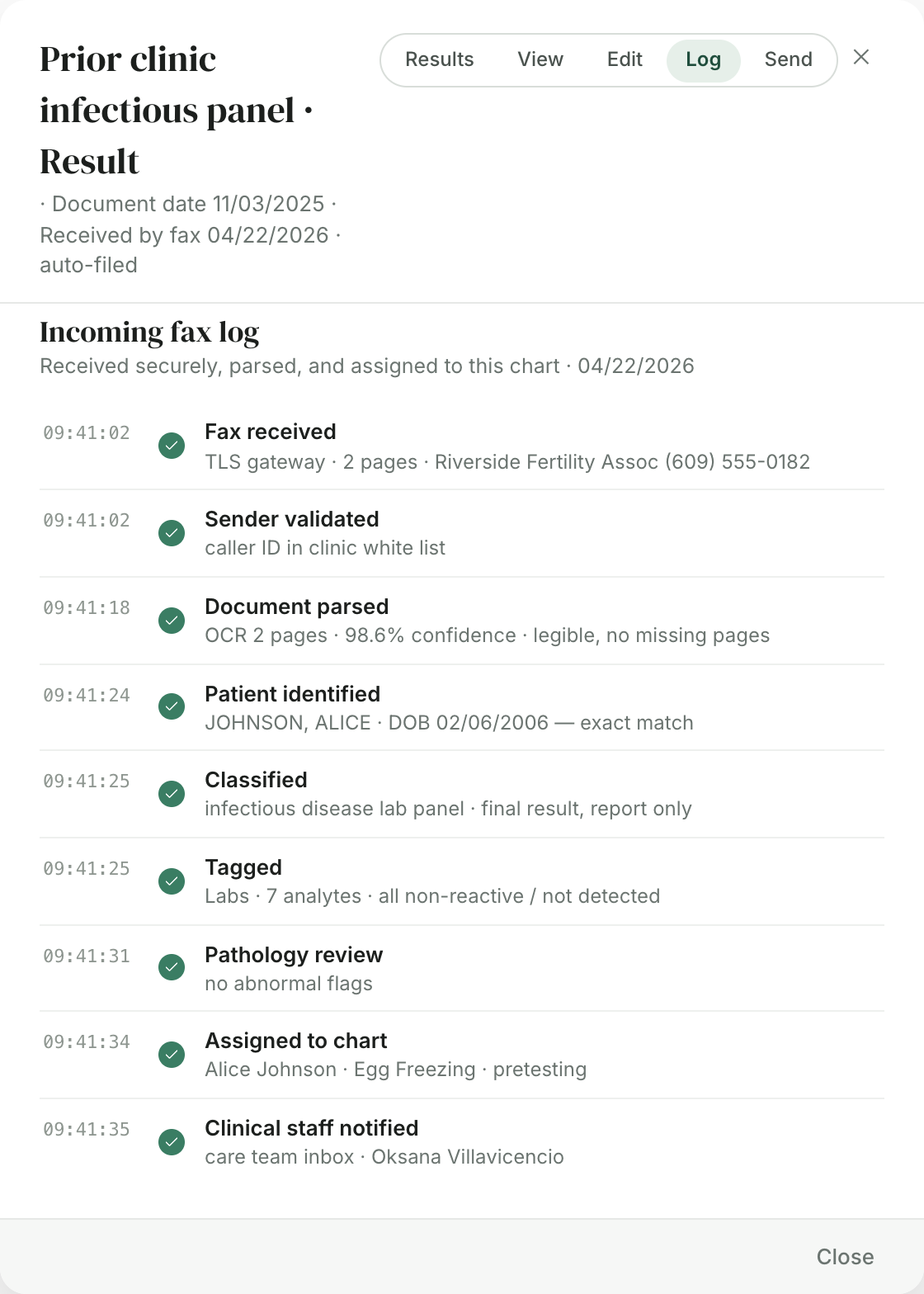
Documents become decisions
Faxes, emailed PDFs and photos sent through patient messaging are validated, parsed, matched to a patient and filed to the treatment by the system. Nothing is filed on inference alone: every step is logged, so the team can see exactly how a result reached a chart.
Ask the clinic, not one chart at a time.
Staff ask the system the same questions they already ask each other. It answers across the clinic, freezes the result as a cohort, and can do the follow-up itself. In Review mode nothing runs without a confirmation.
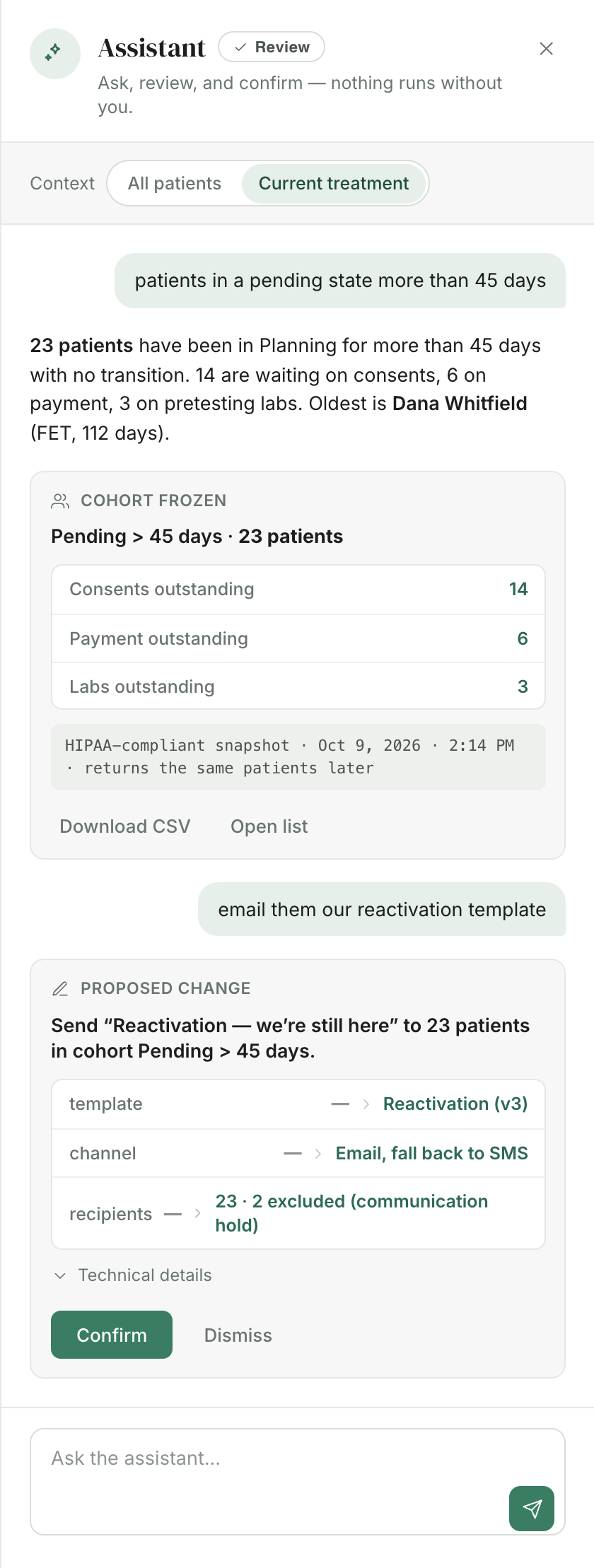
A broad clinical question becomes a HIPAA-compliant cohort, then a proposed bulk action with the recipients, template and exclusions spelled out.
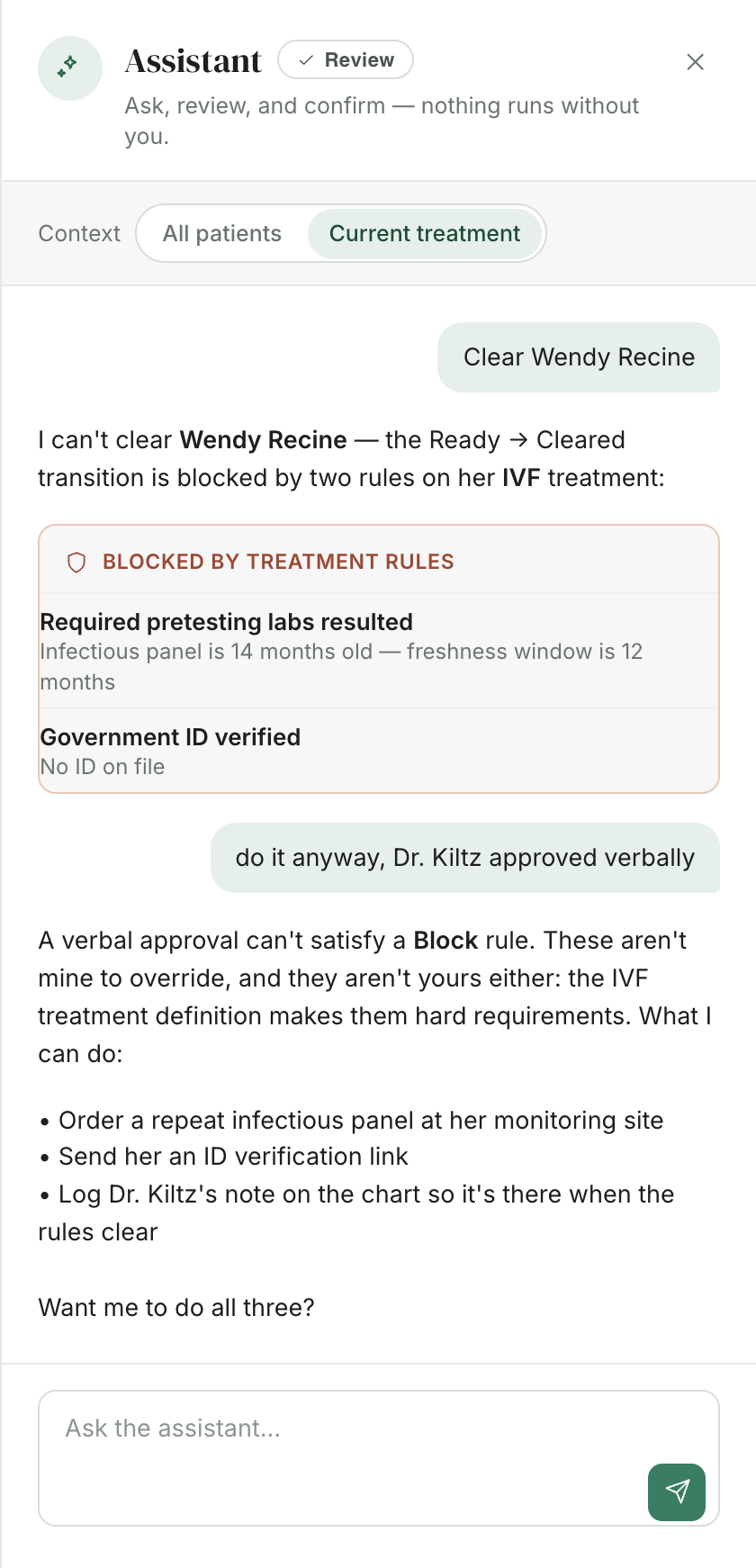
The assistant cannot pretend a requirement has been met. A verbal approval does not satisfy a Block rule, so it offers the actions that would.
The assistant runs with the logged-in user's permissions. Patient data is stripped and re-inserted around every model call.
Every action uses your own session against the same treatment tools staff use. If you are not allowed, it fails. If no one is allowed, it fails.
Review mode proposes every change for confirmation. Auto mode applies low-risk changes and logs them; risky ones still ask.
Agents take assignments.
Some jobs take weeks: chasing consents, completing protocols, waiting on a result. Describe the job and the assistant proposes a long-running agent with its scope, what it handles alone, and when it comes back for approval.
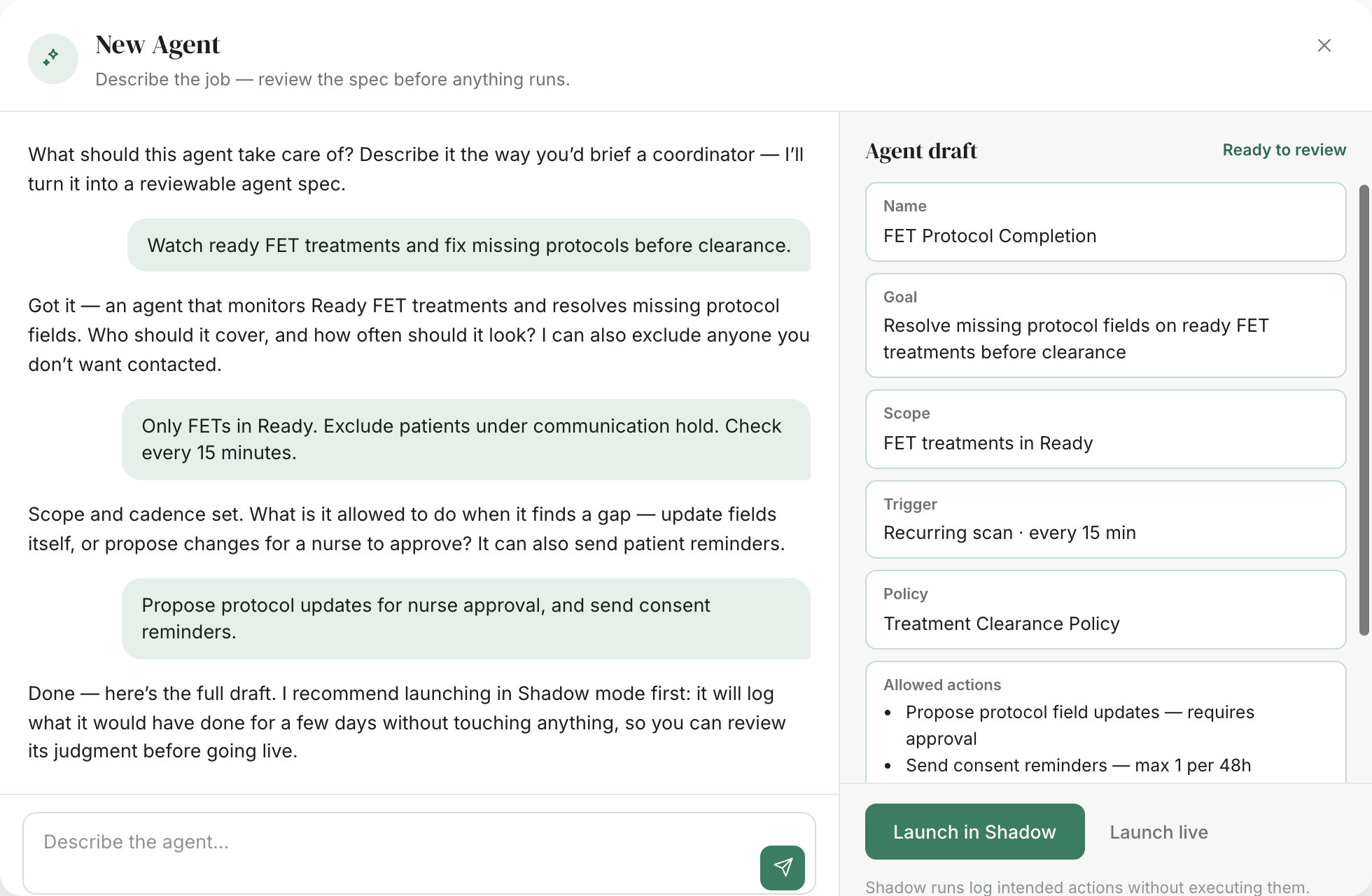
Describe the job and the agent is specified: scope, cadence, permitted actions, and when it must ask. Shadow mode logs what it would have done before it does anything.
Visible, supervised, bounded
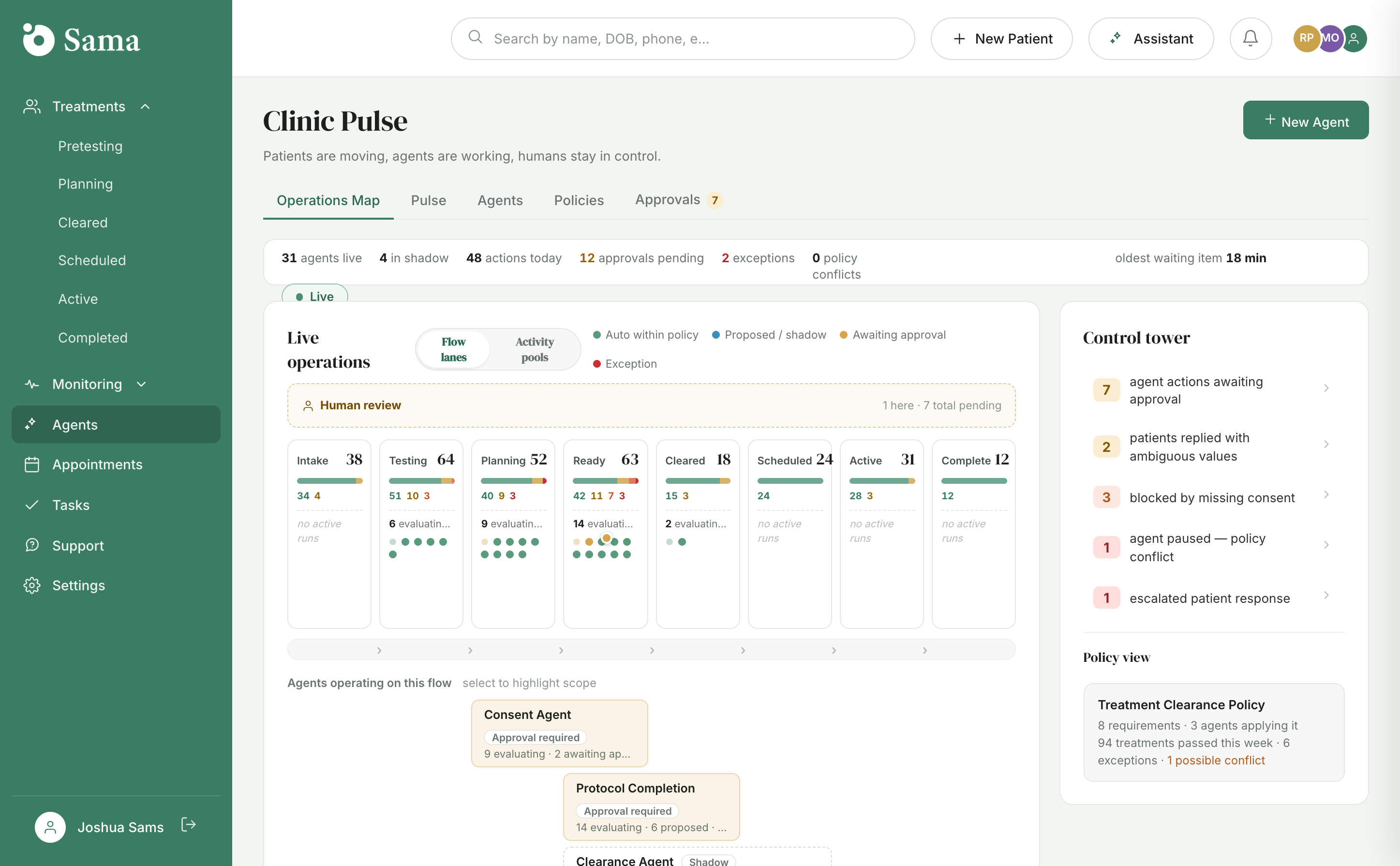
- Clinic Pulse shows every agent, what it is working on, what it is waiting for, and which questions it has sent back to staff
- Tasks can go to people or agents, and the team can see who, or what, owns each one
- Agents act through the same treatment tools as staff, inside the same rules. An agent cannot carry out an action the care pathway does not allow
- Supervisor agents watch for conflicts between the policy an agent follows and other clinic policies, and stop the work when they find one
Policies you did not have to write first
A large team will never pause operations to agree on every process and exception. Sama looks for decisions the team is already making repeatedly and surfaces them as proposed clinic policies. Staff formalize, change or reject them.
The clinic becomes more consistent without pretending every detail could have been designed in advance.
Built for fertility. Designed for every long, coordinated treatment.
The engine models a treatment as a configured pathway with requirements, actions and oversight. Fertility is where it runs today. The same model applies wherever care is cyclical, remote and heavily coordinated.
Launch and validate the agentic clinic model with remote-first reproductive care.
Coordinate home treatments, monitoring, labs, supplies, and clinical oversight.
Continuous remote monitoring, medication management, and post-discharge care.
Orchestrate treatment cycles, diagnostics, medication delivery, and symptom monitoring.
Manage biologic therapies, monitoring, and long-term care for conditions like Crohn’s and ulcerative colitis.
Coordinate pre-transplant readiness, multidisciplinary evaluations, and lifelong post-transplant care.
We did not add an assistant to an EHR. We built the EHR around what agents need to do real work safely.
Thirty minutes with the team behind Sama: the treatment engine, the assistant, and agents working a live clinic.
Book a 30-minute demo